
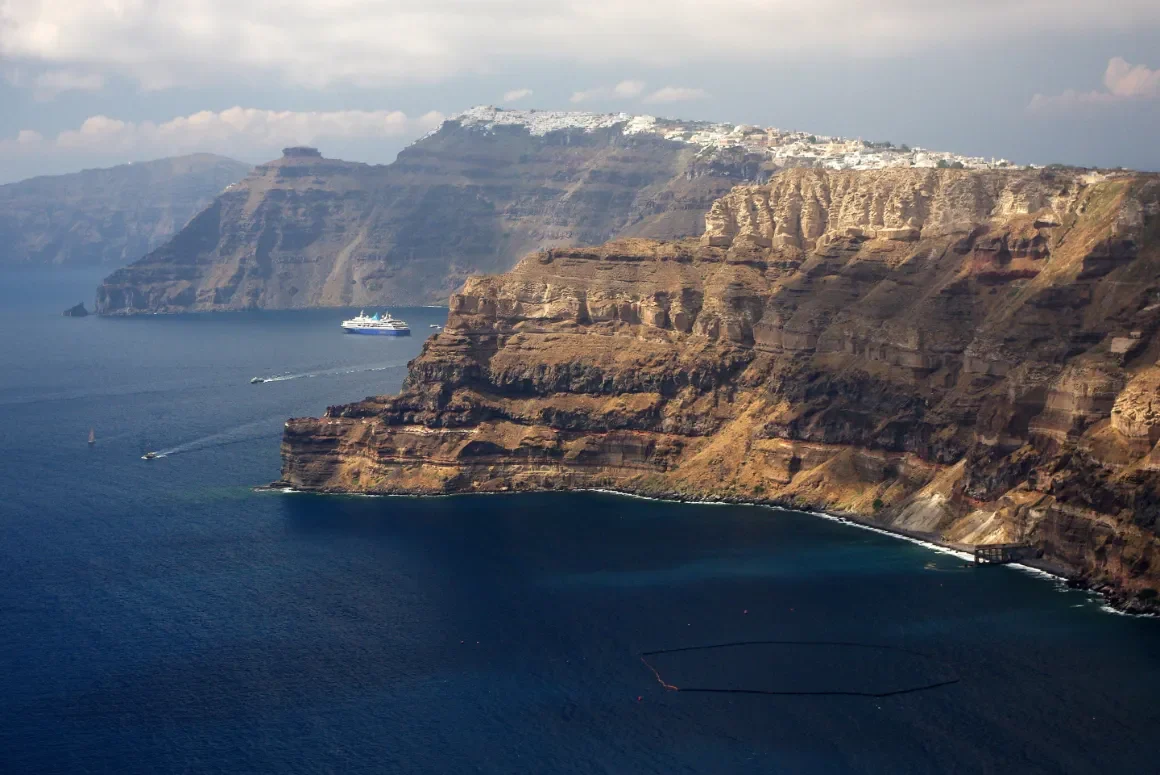
The Cycladic Islands
Fascinating connections to the wider ancient world
The Cycladic Islands are archaeologically important for the emergence of Europe’s first civilisation, and as a continuing link between developments in Europe, the Near East and Egypt.
Sea Routes: Integral to early seafaring across the Mediterranean, the Cycladic Islands played a prominent role in the early transmission of ideas, flow of trade and movement of people between east and west. Engaged in this wider network of exchange the islands flourished as staging posts on long established sea-routes, and were also able to exploit their own natural resources, notably obsidian from Melos and marble from Paros and Naxos.
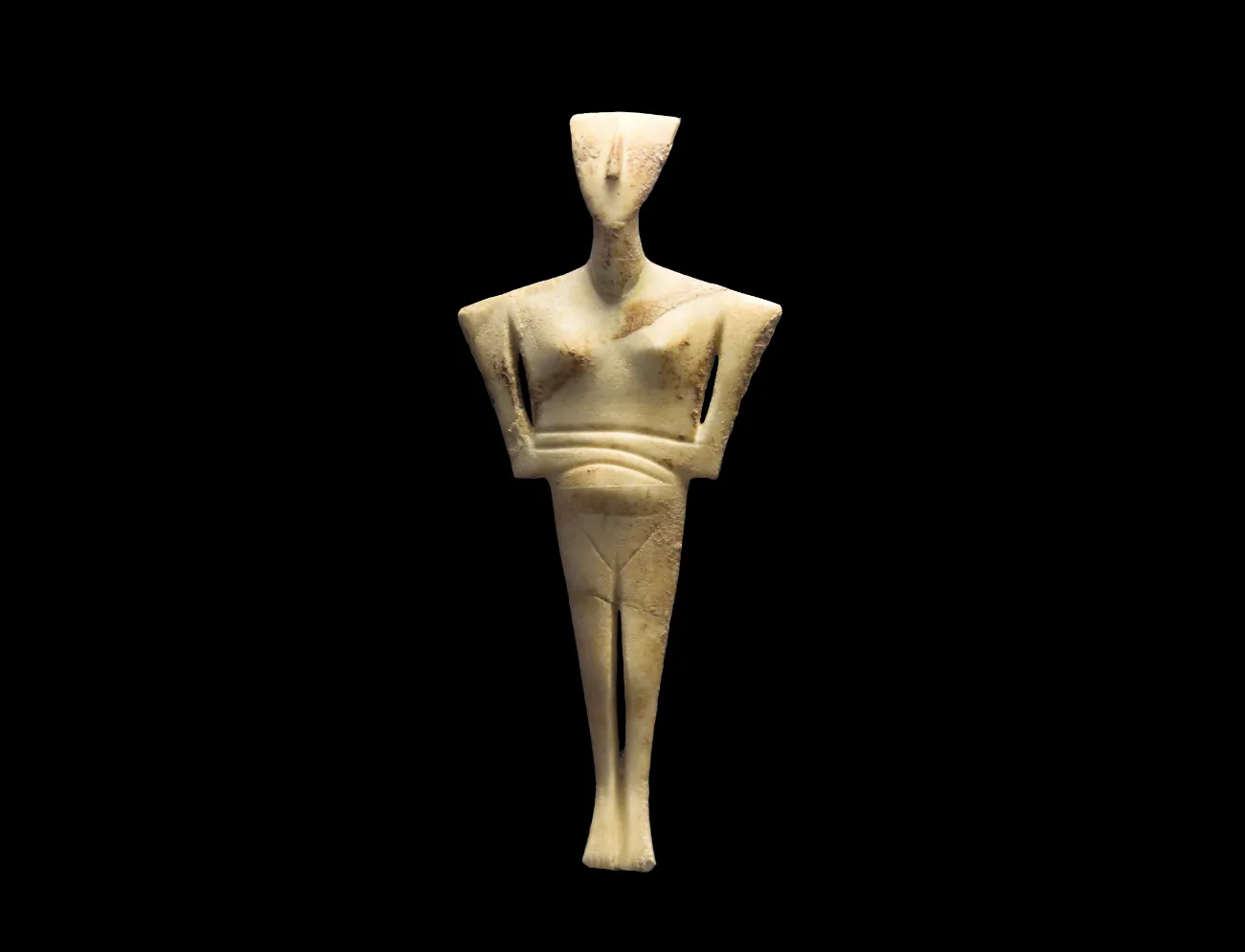
Cycladic Art: On this basis an advanced Bronze Age civilisation arose from about 3000 BC, noted for its distinctive marble figurines. This Cycladic Culture provided roots for the emergence of the complex, palace-based societies of the Minoans and the Mycenaeans of the 2nd millennium BC, which in turn laid cultural foundations carried through into Classical Greece and Rome.
-
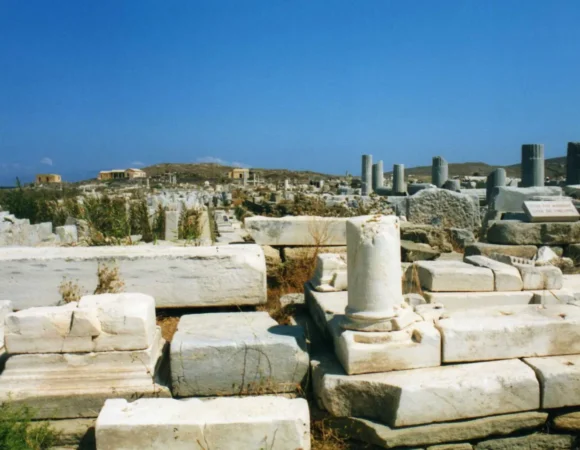
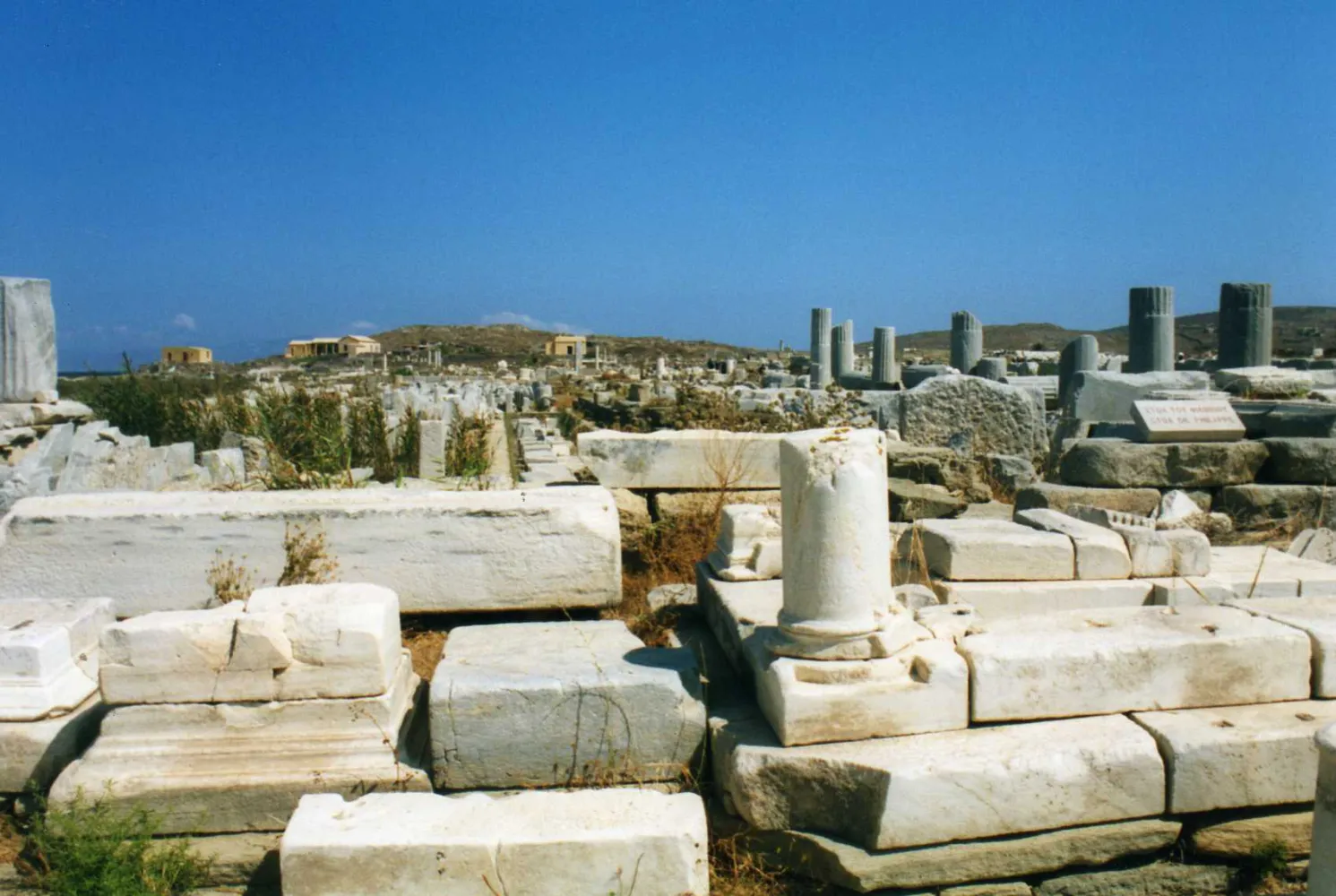
- The Island of Delos was revered as the birthplace of the god Apollo [1]
-
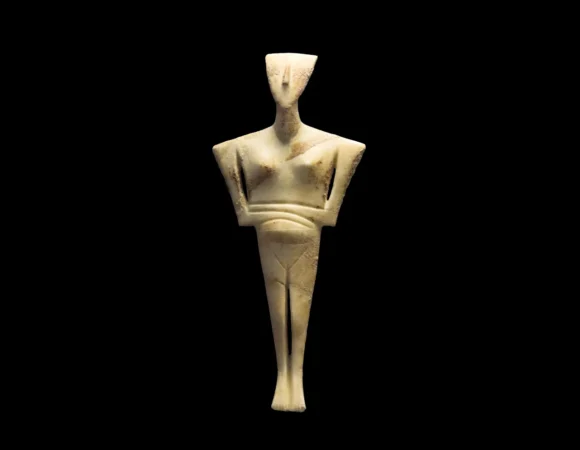
- Human representation carved in marble by a Cycladic artist in the 3rd millennium BC [2]
Classical Mythology: The deep ancestry of the Cyclades was remembered through myths and legends, and most of the islands feature in ancient Greek and Roman mythology. The reality behind the myths can be explored through important archaeological remains, particularly in Delos, Santorini and Naxos. These date from Bronze Age, Archaic, Classical, Hellenistic and Roman times, and they yield fascinating connections to the wider ancient world.
World Heritage: The World Heritage site of Delos, for example, was revered as the birthplace of Apollo, symbolising how the light of human reason came to Greece from the east. And Santorini, whose volcano destroyed Minoan civilisation and plunged the world into a dark age, now preserves the Bronze Age equivalent of Roman Pompeii. Christianity produced some beautiful examples of Byzantine art and architecture, and subsequent Venetian rule, particularly under the ‘Duke of Naxos’, created splendid castles.
Recommended Publications:
“Greece: An Oxford Archaeological Guide” by Christopher Mee and Anthony Spawforth.
Oxford University Press, 2001 (paperback), 480 pages, ISBN: 978-0192880581
Probably the best guidebook to the archaeological sites of Greece. The authors, both professors of classical archaeology, write from an on-the-ground point of view about more than a hundred sites from prehistory to the sixth century AD, and provide plenty of illustrations and useful background context.
“Greek Archaeology” by Christopher Mee.
Wiley-Blackwell, 2011 (paperback), 376 pages, ISBN: 978-1405167338
A thoroughly contemporary overview from the Neolithic to the Hellenistic periods attractively presented and illustrated, and made more interesting by its thematic rather than more mundane chronological approach. Recommended reading for all.
“The Archaeology of Athens” by John Camp.
Yale University Press, 2004 (paperback), 352 pages, ISBN: 978-0300101515
For a more detailed look specifically at the archaeological sites of Athens and neighbouring sites in Attica, this book provides a great starting point. There is plenty of up-to-date evidence and detail presented in a clear, straightforward structure and skillfully interwoven with visual images of how the monuments and sites actually looked.
“A Brief History of Ancient Greece: Politics, Society and Culture” by Sarah Pomeroy, Stanley Burstein, Walter Donlan and Jennifer Tolbert Roberts.
Oxford University Press USA, 2009 (paperback), 400 pages, ISBN: 978-0195372359
Recommended by the Open University, and quite thorough for a ‘brief history’, this is a satisfying introduction to the world of ancient Greece with a reasonably detailed and honest appraisal of the evidence from the most important sites, and suitable pointers to further reading.
“Events That Changed Ancient Greece” by Bella Vivante (editor)
Greenwood Press, 2001 (hardcover), 238 pages, ISBN: 978-0313316395
A stimulating and accessible survey of the most significant events that shaped ancient Greece, from the Mycenaean period to the conquests of Alexander the Great. This is not a guidebook to the sites but is a companion reader for expanding on their general cultural and chronological context. Written by acknowledged scholars, this collection of essays successfully highlights the important themes and questions in the study of ancient Greek civilisation.
“Sanctuaries and the Sacred in the Ancient Greek World” by John Pedley.
Cambridge University Press, 2005 (paperback), 292 pages, ISBN: 978-0521006354
An authoritative look at the religious sanctuaries which were so central to ancient Greek civilisation. This is a masterly survey of the sites, themes and issues which defined the relationships between Greeks and their gods. It covers the great Panhellenic sanctuaries such as Olympia and Delphi as well as the urban sanctuaries of individual city-states, such as the Acropolis of Athens.
“The Greek and Roman Myths: A Guide to the Classical Stories” by Philip Matyszak.
Thames and Hudson, 2010 (hardcover), 224 pages, ISBN: 978-0500251737
There are numerous books on Greek mythology but this is certainly one of the most enjoyable and informative. It is not a glossy, touristy regurgitation of the obvious, nor an obscure, scholarly treatise, but rather a balanced insight presented in an attractive, portable format. A handy guide written by a bestselling author on ancient Greece.
“Greek Art” by John Boardman (World of Art Series).
Thames and Hudson, 1996 (paperback), 304 pages, ISBN: 978-0500202920
Great value from Professor Boardman, this work stands the test of time as an intelligent analysis of developments in architecture, sculpture and pottery in ancient Greece, and is well illustrated throughout.
“A Guide to Greek Theatre and Drama” by Kenneth McLeish.
Methuen Drama 2003 (paperback), 320 pages, ISBN: 978-0413720306
This definitive yet accessible guide provides a well-researched survey of all the main plays of ancient Greece, with a synopsis and a deeper analysis of each, together with fascinating insights into the general theory and practice of theatre and drama.
“Retrieving the Ancients: An Introduction to Greek Philosophy” by David Roochnik.
Wiley-Blackwell, 2004 (paperback), 248 pages, ISBN: 978-1405108621
One of the clearest introductions to this vastly engaging subject.
Classics:
“Guide to Greece” by Pausanias. Two volumes. Translation by Peter Levi.
Penguin Classics, 1979 (paperback), Vol.1 608 pages, ISBN: 978-0140442250. Vol.2 560 pages, ISBN: 978-0140442267
These two volumes have long been a favourite of travellers to Greece. Written in the 2nd century AD as a guidebook for Roman tourists they give a vivid contemporary account of the monuments, and also delve into their historical and mythological background. Volume one covers Central Greece, including Athens, Corinth and Thebes and a compelling depiction of the Oracle at Delphi. Volume Two explores Southern Greece including Sparta, Arkadia, Bassae and the games at Olympia.
“The Iliad” and “The Odyssey” by Homer. Two volumes. Translation by E.V. Rieu.
Penguin Classics, 2003 (paperback), The Iliad 560 pages, ISBN: 978-0140447941. The Odyssey 416 pages, ISBN: 978-0140449112
It is said that Alexander the Great carried a copy of Homer on his campaigns to spread Hellenic ideals, and if you feel like truly immersing yourself in ancient Greece then perhaps you should carry one too. These two epic tales stand as the earliest works in western literature, and were fundamental to classical culture and ideals. These modern translations by the celebrated E.V. Rieu are in more readable prose rather than the poetic style of the original storytellers.
Image Attributes
[1] Leonora Enking – Flickr: Delos, CC BY-SA 2.0, Source
[2] Zde, CC BY-SA 3.0, Source
[Feature image] Joe MiGo, Copyrighted free use, Source


