
Crete
A wonderful itinerary of impressive ruins
As the largest of the Greek islands, Crete’s size and position has long ensured its role in the maritime trade networks of the Mediterranean.
In prehistory the island flourished quickly through contact with Egypt and the Near East, and the emergence here of palace-based societies around 2000 BC is the first clear evidence of ‘civilisation’ reaching Europe. These were the Minoans, whose cultural legacy to Greek civilisation was remembered in Greek mythology; the famous palace at Knossos, for example, is widely regarded as the home of legendary King Minos and the mythical minotaur.
The Minoans: British archaeologist Sir Arthur Evans pioneered excavations at Knossos in the early 20th century, substantiating the reality behind the myths, and since then many other ancient sites have been brought to light across the island; Phaistos, Malia, Sitia and Gournia all contribute to a wonderful itinerary of impressive ruins set amid beautiful and dramatic scenery. The creativity and vitality of Minoan society reached its zenith between 1700 and 1450 BC, the golden age of the palaces, and the Archaeological Museum in Heraklion houses a superb collection of extremely fine pottery, goldwork and frescoes from this apparently peaceful and artistic society.
Dark Times: The effects on Crete of the eruption of Thera (Santorini) remains a fascinating line of enquiry, but certainly it is clear that by about 1400 BC Mycenaeans from mainland Greece had taken control of the Minoan palaces, and by about 1100 BC the whole palace system had collapsed, not only on Crete but across the entire eastern Mediterranean. Reorganisation of palace society into the city-states of Archaic and Classical times saw Crete continue its maritime transmition of influences from the east into Europe, but the thrust of cultural development was now with mainland Greece.
Roman Crete: Ignored by Alexander the Great, Crete gained a reputation for its mercenaries and pirates, and it held out against Rome until 67 BC, when Roman annexation finally brought some stability to island politics. Gortyn was chosen as the Roman capital, and the island remained largely peaceful and prosperous for the bulk of Roman rule. Its quiet transfer into Byzantine hands in the 4th century AD ensured safe preservation of its classical outlook which resurfaced during the Venetian occupation from 1204 – 1669.
Renaissance: The Venetians built mighty fortresses, such as that at Heraklion, and also monasteries which became centres of classical learning, such as those at Toplou and Kritsa. By this time Crete became a refuge for Greeks fleeing the Ottoman conquests, and here they established the influential ‘Cretan School’ of art, famous for its icon painting and contribution to the Renaissance. El Greco, who was born on Crete in 1541, is the most famous product of this school, and two of his paintings are displayed in Heraklion’s Historical Museum.
-
- Bull's Head Rhyton from Minoan Knossos. Carved in steatite with gilded wood horns [1]

-
- Archaeological site of Lato [2]
-
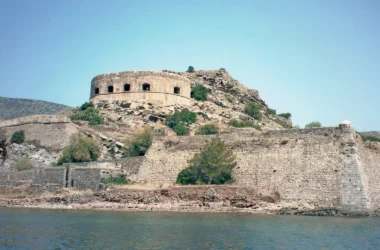
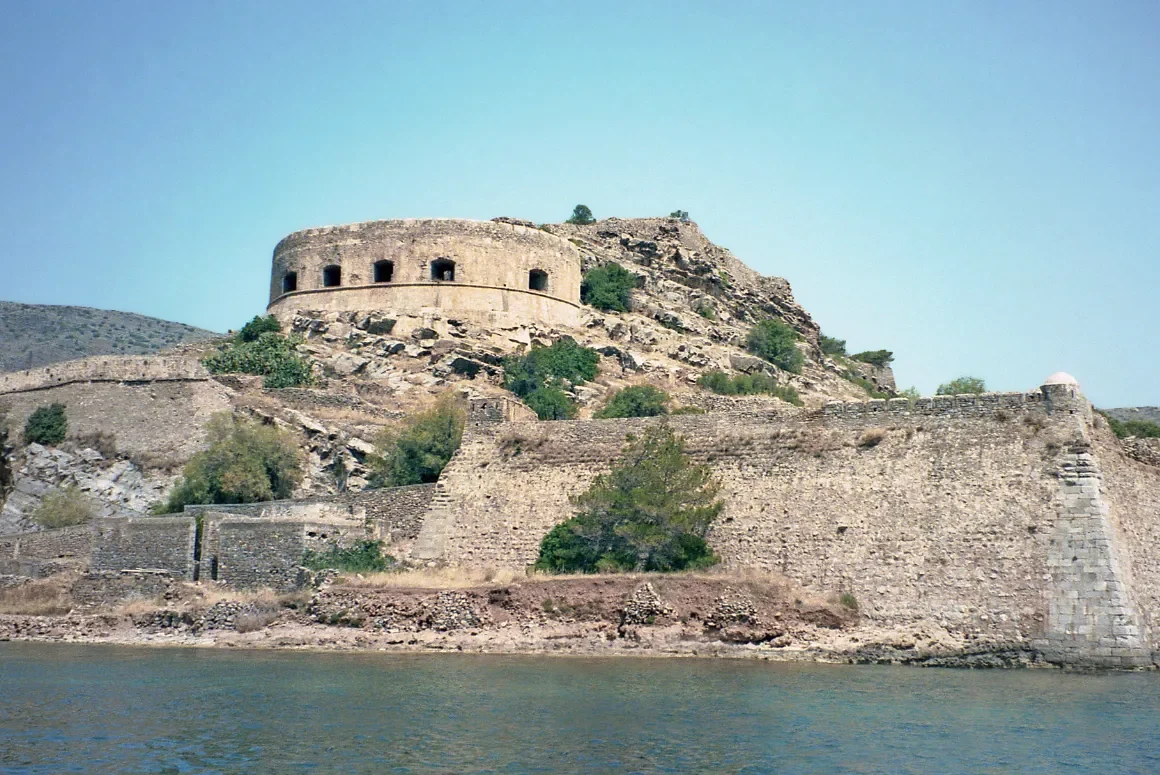
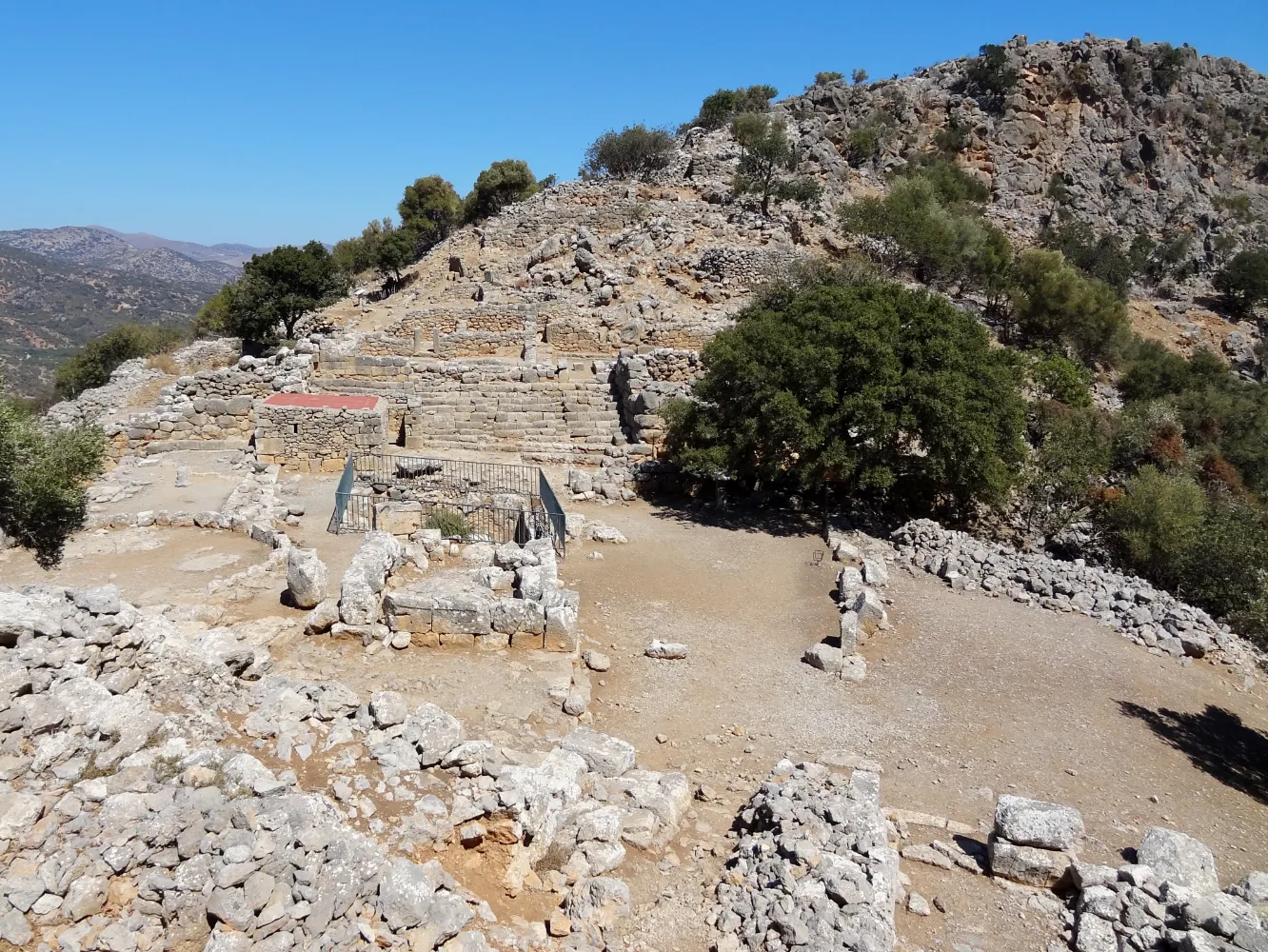
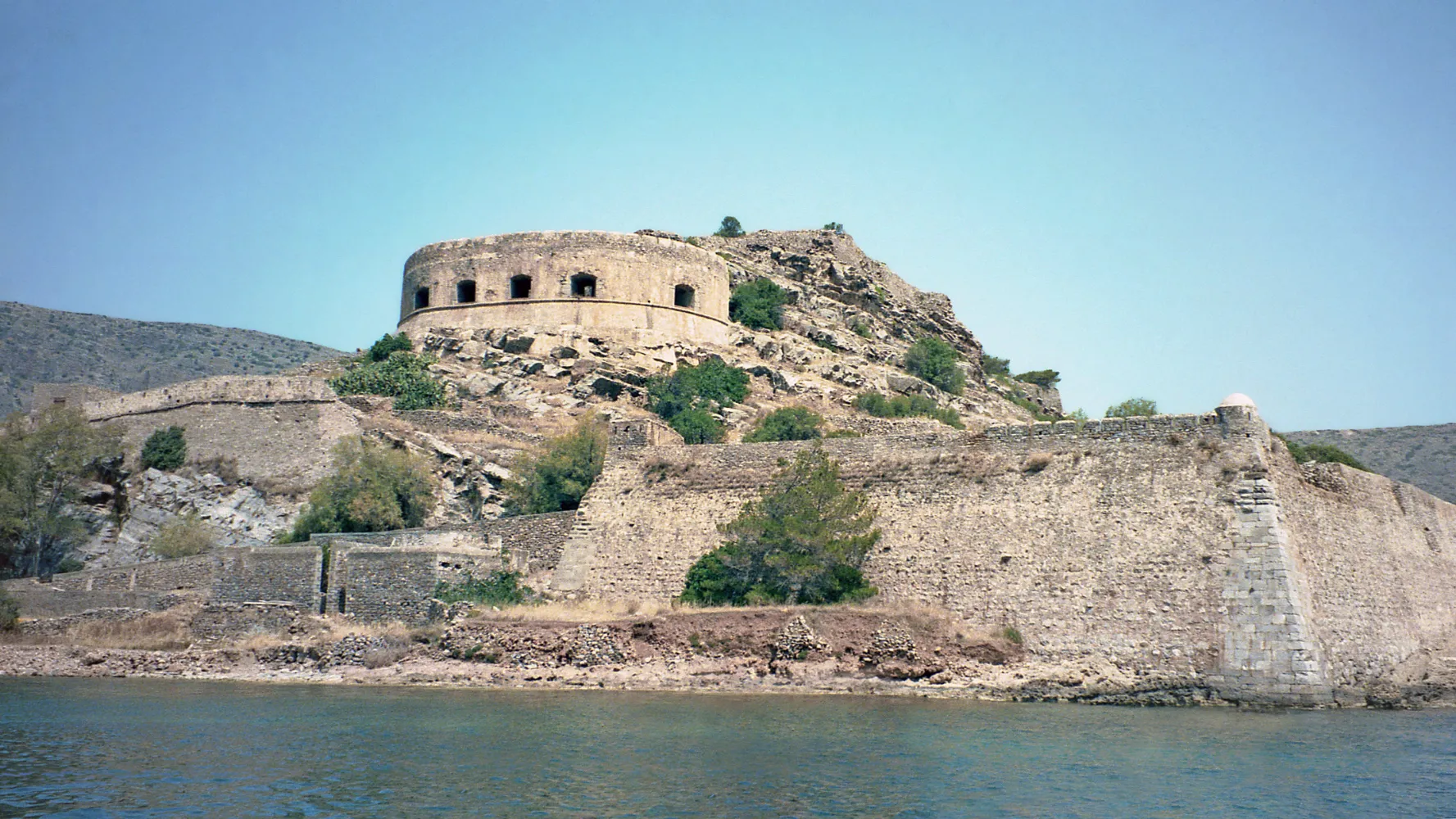
- The island fortress of Spinalonga; originally an ancient acropolis, refortified by the Venetians and then used as a leper colony for the first half of the 20th century [3]
Recommended Publications:
“Greece: An Oxford Archaeological Guide” by Christopher Mee and Anthony Spawforth.
Oxford University Press, 2001 (paperback), 480 pages, ISBN: 978-0192880581
Probably the best guidebook to the archaeological sites of Greece. The authors, both professors of classical archaeology, write from an on-the-ground point of view about more than a hundred sites from prehistory to the sixth century AD, and provide plenty of illustrations and useful background context.
“Greek Archaeology” by Christopher Mee.
Wiley-Blackwell, 2011 (paperback), 376 pages, ISBN: 978-1405167338
A thoroughly contemporary overview from the Neolithic to the Hellenistic periods attractively presented and illustrated, and made more interesting by its thematic rather than more mundane chronological approach. Recommended reading for all.
“The Archaeology of Athens” by John Camp.
Yale University Press, 2004 (paperback), 352 pages, ISBN: 978-0300101515
For a more detailed look specifically at the archaeological sites of Athens and neighbouring sites in Attica, this book provides a great starting point. There is plenty of up-to-date evidence and detail presented in a clear, straightforward structure and skillfully interwoven with visual images of how the monuments and sites actually looked.
“A Brief History of Ancient Greece: Politics, Society and Culture” by Sarah Pomeroy, Stanley Burstein, Walter Donlan and Jennifer Tolbert Roberts.
Oxford University Press USA, 2009 (paperback), 400 pages, ISBN: 978-0195372359
Recommended by the Open University, and quite thorough for a ‘brief history’, this is a satisfying introduction to the world of ancient Greece with a reasonably detailed and honest appraisal of the evidence from the most important sites, and suitable pointers to further reading.
“Events That Changed Ancient Greece” by Bella Vivante (editor)
Greenwood Press, 2001 (hardcover), 238 pages, ISBN: 978-0313316395
A stimulating and accessible survey of the most significant events that shaped ancient Greece, from the Mycenaean period to the conquests of Alexander the Great. This is not a guidebook to the sites but is a companion reader for expanding on their general cultural and chronological context. Written by acknowledged scholars, this collection of essays successfully highlights the important themes and questions in the study of ancient Greek civilisation.
“Sanctuaries and the Sacred in the Ancient Greek World” by John Pedley.
Cambridge University Press, 2005 (paperback), 292 pages, ISBN: 978-0521006354
An authoritative look at the religious sanctuaries which were so central to ancient Greek civilisation. This is a masterly survey of the sites, themes and issues which defined the relationships between Greeks and their gods. It covers the great Panhellenic sanctuaries such as Olympia and Delphi as well as the urban sanctuaries of individual city-states, such as the Acropolis of Athens.
“The Greek and Roman Myths: A Guide to the Classical Stories” by Philip Matyszak.
Thames and Hudson, 2010 (hardcover), 224 pages, ISBN: 978-0500251737
There are numerous books on Greek mythology but this is certainly one of the most enjoyable and informative. It is not a glossy, touristy regurgitation of the obvious, nor an obscure, scholarly treatise, but rather a balanced insight presented in an attractive, portable format. A handy guide written by a bestselling author on ancient Greece.
“Greek Art” by John Boardman (World of Art Series).
Thames and Hudson, 1996 (paperback), 304 pages, ISBN: 978-0500202920
Great value from Professor Boardman, this work stands the test of time as an intelligent analysis of developments in architecture, sculpture and pottery in ancient Greece, and is well illustrated throughout.
“A Guide to Greek Theatre and Drama” by Kenneth McLeish.
Methuen Drama 2003 (paperback), 320 pages, ISBN: 978-0413720306
This definitive yet accessible guide provides a well-researched survey of all the main plays of ancient Greece, with a synopsis and a deeper analysis of each, together with fascinating insights into the general theory and practice of theatre and drama.
“Retrieving the Ancients: An Introduction to Greek Philosophy” by David Roochnik.
Wiley-Blackwell, 2004 (paperback), 248 pages, ISBN: 978-1405108621
One of the clearest introductions to this vastly engaging subject.
Classics:
“Guide to Greece” by Pausanias. Two volumes. Translation by Peter Levi.
Penguin Classics, 1979 (paperback), Vol.1 608 pages, ISBN: 978-0140442250. Vol.2 560 pages, ISBN: 978-0140442267
These two volumes have long been a favourite of travellers to Greece. Written in the 2nd century AD as a guidebook for Roman tourists they give a vivid contemporary account of the monuments, and also delve into their historical and mythological background. Volume one covers Central Greece, including Athens, Corinth and Thebes and a compelling depiction of the Oracle at Delphi. Volume Two explores Southern Greece including Sparta, Arkadia, Bassae and the games at Olympia.
“The Iliad” and “The Odyssey” by Homer. Two volumes. Translation by E.V. Rieu.
Penguin Classics, 2003 (paperback), The Iliad 560 pages, ISBN: 978-0140447941. The Odyssey 416 pages, ISBN: 978-0140449112
It is said that Alexander the Great carried a copy of Homer on his campaigns to spread Hellenic ideals, and if you feel like truly immersing yourself in ancient Greece then perhaps you should carry one too. These two epic tales stand as the earliest works in western literature, and were fundamental to classical culture and ideals. These modern translations by the celebrated E.V. Rieu are in more readable prose rather than the poetic style of the original storytellers.
Image Attributes
[1] Carole Raddato, CC BY-SA 2.0, Source
[2] Olaf Tausch, CC BY 3.0, Source
[3] Robert Linsdell, CC BY 2.0, Source
[Feature image] See attribute [3]


